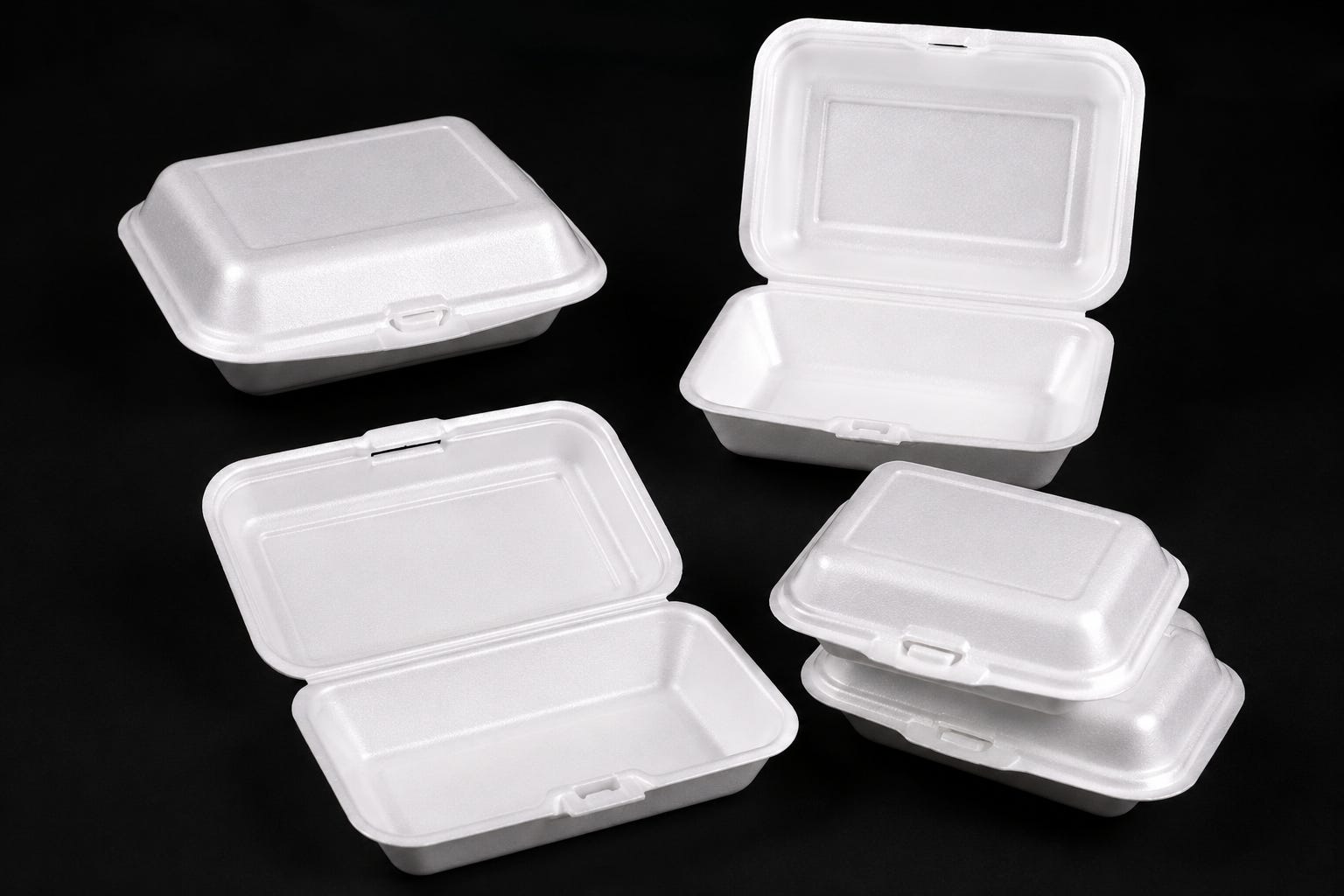
Picture this: It’s a Thursday afternoon at a waakye spot somewhere on the busy stretch around Accra’s Tema Station. A woman scoops rice and beans into a styrofoam container, drops two pieces of fried fish on top, tucks in a small sachet of shito, and snaps the lid shut. You hand over your ₵25, collect the pack, find a ledge to sit on, and eat. When you’re done, you drop the container on the ground, kick it slightly to the side out of nothing but instinct and sheer wickedness, and walk away. The container sits there. The rain moves it. A gutter carries it. Eventually, it ends up somewhere that is not your problem.
This scene plays out millions of times a day across Ghana. Styrofoam is so deeply embedded in Ghana’s food economy that most people have stopped seeing it at all. It has become almost invisible. But that invisibility has a cost. And Ghana has finally decided it can no longer afford to ignore it.
Ghana just outlawed styrofoam. The announcement has been building for a year. President Mahama first signalled the policy at the 2025 World Environment Day celebrations, describing Styrofoam as one of Ghana's most "pernicious polluters." That was no hyperbole. Polystyrene does not biodegrade. It photodegrades, breaking into smaller and smaller particles that persist in soil and water for centuries. In Accra, it clogs drainage channels and contributes directly to the seasonal flooding that destroys property and costs lives. It has been found to leach styrene, a potential carcinogen, into hot food and beverages. Amidst all that, there is a second story here that is not getting nearly enough attention, and that is what this piece seeks to address.
Let’s start where the conversation usually starts, and where it deserves serious attention.
Styrofoam, or expanded polystyrene foam, is one of the most environmentally hostile materials in everyday use. It does not biodegrade in any meaningful timeframe. A styrofoam container tossed outside a chop bar in Accra today will still exist, in essentially the same form, decades from now. It does not break down into organic matter. It breaks down into smaller and smaller pieces of plastic, called microplastics, that enter the soil, water, and eventually the food chain.
Ghana’s waterways are suffering visibly. The flooding, especially during a rainy season like this one, that devastates low-lying neighborhoods in Accra is partly a drainage problem, and styrofoam is a significant contributor. Gutters and storm drains clogged with food packaging overwhelm systems that were already underpowered. The water has nowhere to go, so it takes everything with it; roads, property and even lives.
Beyond flooding, there is the ocean to consider. Ghana has over 500 kilometres of coastline, and much of the plastic waste generated inland finds its way to the sea. Expanded polystyrene is particularly dangerous in marine environments because it fragments easily and is nearly impossible to remove once dispersed. Several beaches in Accra face this issue. Fish and seabirds ingest it. It accumulates up the food chain. Fishing communities along Ghana’s coasts, whose livelihoods and nutrition depend directly on healthy marine ecosystems bear a disproportionate share of the consequences of packaging decisions made all over the country.
Then there is the public health dimension. Styrofoam contains styrene, a chemical compound that has been classified as a possible human carcinogen. When hot food is packed into styrofoam containers, as it almost always is, there is evidence that chemicals leach from the packaging into the food itself. The people most exposed to this are not wealthy consumers with alternatives. They are everyday Ghanaians eating their lunch from a food vendor’s stall, often unaware that the container they are eating from may be contributing, in small but cumulative ways, to their health risks over time.
The ban, from a purely environmental and public health standpoint, is the right call. Rwanda understood this a generation ago. Kenya has been aggressive about it. Nigeria made a move a whole year before us, and are actively implementing it. The rest of the world is moving in this direction, and Ghana, with its climate vulnerabilities and the pressure on its coastal and urban environments, has every reason to join the masses.
That said, the most important question now is not whether the ban is right. It is: what happens next?
One of the most common criticisms of Ghana’s styrofoam ban so far has been that it is not being implemented immediately. To some, this signals a lack of seriousness. But this criticism misconstrues how transformative and industrial policy actually has to work.
No matter how environmentally convenient it would be, consider what would happen if the ban took effect overnight. Thousands of food vendors, restaurants, caterers, and market traders currently hold styrofoam stock they have already paid for. Stock that would become instantly worthless. Distributors and wholesalers have filled warehouses with inventory that would suddenly have no legal market. There are importers with containers already on ships bound for Ghana. Beyond the stock problem is the supply problem. The alternative packaging industry in Ghana is simply not yet equipped to absorb the full demand currently served by styrofoam. If every food vendor tried to switch tomorrow, prices would spike sharply, and the vendors who would suffer most are the small ones; the same people with the thinnest margins and the fewest options.
A rushed ban solves nothing. It just redistributes the pain to the most economically vulnerable actors in the food system.
The transition period is not a sign of weakness but a preparation period. And for entrepreneurs, it is something more valuable still: a beautiful head start.
Here is what the environmental conversation and heuristic tends to crowd out: every major regulatory shift creates a market. This is a basic finance principle.
Ghana’s food packaging industry is enormous. It services hundreds of thousands of restaurants, food vendors, fast food chains, caterers, schools, hospitals, corporate cafeterias, and street food sellers. Every single one of them will need an alternative to styrofoam. That is not a problem to be managed, but a business opportunity to be seized.
The window will not be open for long. But right now, it is wide, with little to no competition.
Think about what the post-styrofoam packaging economy in Ghana actually requires, and then think about who could build each piece of it. Here are some amazing actors in a functional post-styrofoam packaging economy in no particular order.
Biodegradable packaging producers represent one of the most exciting opportunities, particularly for those willing to look at Ghana’s agricultural waste not as a disposal problem but as a raw material. Materials such as sugarcane residue, coconut husks, corn stalks, cassava starch and plantain waste are all viable feedstocks for compostable food containers. Small factories in India and Indonesia have already proven this model. A Ghanaian engineer or agro-processing entrepreneur who figures out this supply chain locally won’t just building a business, but an industry from scratch, with all the advantages that come with buying in early.
Kraft paper packaging is another significant opportunity that is already gaining ground globally and deserves far more attention in Ghana. The strong, brown, unbleached paper used in paper bags and wrapping is durable, grease-resistant when treated, fully biodegradable, and widely accepted by consumers as a sustainable alternative to plastic. Paper bags, paper trays, and paper-based food wraps made from kraft are already used extensively by food businesses in Europe and increasingly in West Africa. A local manufacturer who is able to produce quality kraft paper packaging at competitive prices, or even an importer who establishes a reliable supply chain and distribution network, would be positioning itself for a very large and very near-term shift in demand.
Leaf packaging known locally as ahaban deserves a special mention, because it represents something rare in this conversation: a solution that is not only sustainable but deeply rooted in Ghanaian food culture. Leaves have been used to wrap and serve food across Ghana for generations. The practice never fully disappeared; it was simply displaced by cheaper plastic alternatives. There is now a real and growing opportunity for farmers, distributors, and packaging suppliers who work with leaf materials to reenter the mainstream market. Someone who builds a clean, reliable, commercially scaled supply chain for food-grade leaf packaging would be solving a problem that no one has formally organized around yet. The cultural credibility is already there. It just needs a business around it.
Campus startups and young entrepreneurs are particularly well-placed for this moment. Young entrepreneurs often assume that major industries are built by established corporations.
History suggests otherwise.
Many transformative companies started when founders noticed a shift in the market before everyone else.
Students today have access to tools that previous generations did not.
Rapid prototyping. AI-assisted research. Online marketplaces. Digital marketing.
A university team could begin by researching sustainable packaging materials. Another could create software connecting suppliers with food businesses. Another could build a marketplace specifically for eco-friendly packaging. Another could focus on waste collection and recycling logistics.
The barrier to entry has never been lower.
Consulting and transition services may be the most underrated opening of all. When the ban takes full effect, thousands of food businesses will face the same urgent question: where do I get my packaging now, and how do I make the switch without destroying my margins? A consultant who has already mapped the supplier landscape, vetted and verified product quality, and helped clients transition has an extraordinarily valuable service. You can start this with a laptop, genuine research, and a few early clients willing to work with you.
B2B digital marketplaces connecting restaurants and food vendors to sustainable packaging suppliers are another natural fit. Build the supplier network, build the buyer network, and take a margin on transactions. The network effects compound over time, and the problem is structured perfectly for a platform business.
You do not need a factory or large capital to start. You can begin with distribution. For individuals and startups already in the importation business, you can source eco-friendly containers from a vetted overseas supplier and sell directly them to food businesses in your city.
If you’re the kind who prefers to be build something from the ground up, you can brand a line of sustainable takeaway containers and position it as a statement for food businesses that want to get ahead of the regulation and signal something to their customers. You can build the marketplace. You can offer the consulting. You can start the ahaban supply chain with a handful of farmers and three restaurant clients. None of this requires anything that is not already accessible to an ambitious person in Ghana.
The businesses that start building now will have twelve months of learning, very active iteration, and trust-building that a late mover will never recover. The importer who has tested suppliers and locked in pricing will not be scrambling when demand spikes. The marketplace that has onboarded fifty suppliers will not be starting from zero when the deadline arrives. Preparation is the competitive advantage here.
The ban is important because it addresses a genuine environmental problem that has existed for decades and will continue if subsequent steps are not taken by the responsible regulatory bodies.
But it may prove even more important because it creates incentives for entrepreneurs, manufacturers, investors, and innovators to build something better. That may just be the most exciting part of the story.
If you are already working on something in this space—packaging, distribution, agro-processing, leaf sourcing, sustainability tech, or anything related—I would genuinely love to hear about it. Reach out and share what you are building. And if you have been turning an idea over in your head but haven’t started yet, consider this a very aggresive nudge.